
In Ovid’s Metamorphoses, the Cypriot sculptor, Pygmalion, carves an ivory statue and falls in love with her after being disillusioned with real women and the wickedness of the environment around him. He is no longer capable of enjoying the pleasures of reality; he must shun them and create his own artificial delights.
“Pleas’d with his idol, he commends, admires,
Adores; and last, the thing ador’d, desires.” (p. 254)
Pygmalion dresses the statue, gives gifts of orient pearls, and even takes her to bed. The fantastical element (a conceit modern sci-fi stories have adopted in droves: Her, Ex Machina, The Fifth Element, Black Mirror, Lars and the Real Girl) is one where the girl—and it is always a girl—transcends her quality of objectness and loves him back. The object of desire is visualised; the action of interaction, fantasised; and then the scene, or fetish, is actualised—finally comes the moment to vivify the desire, to perform it.

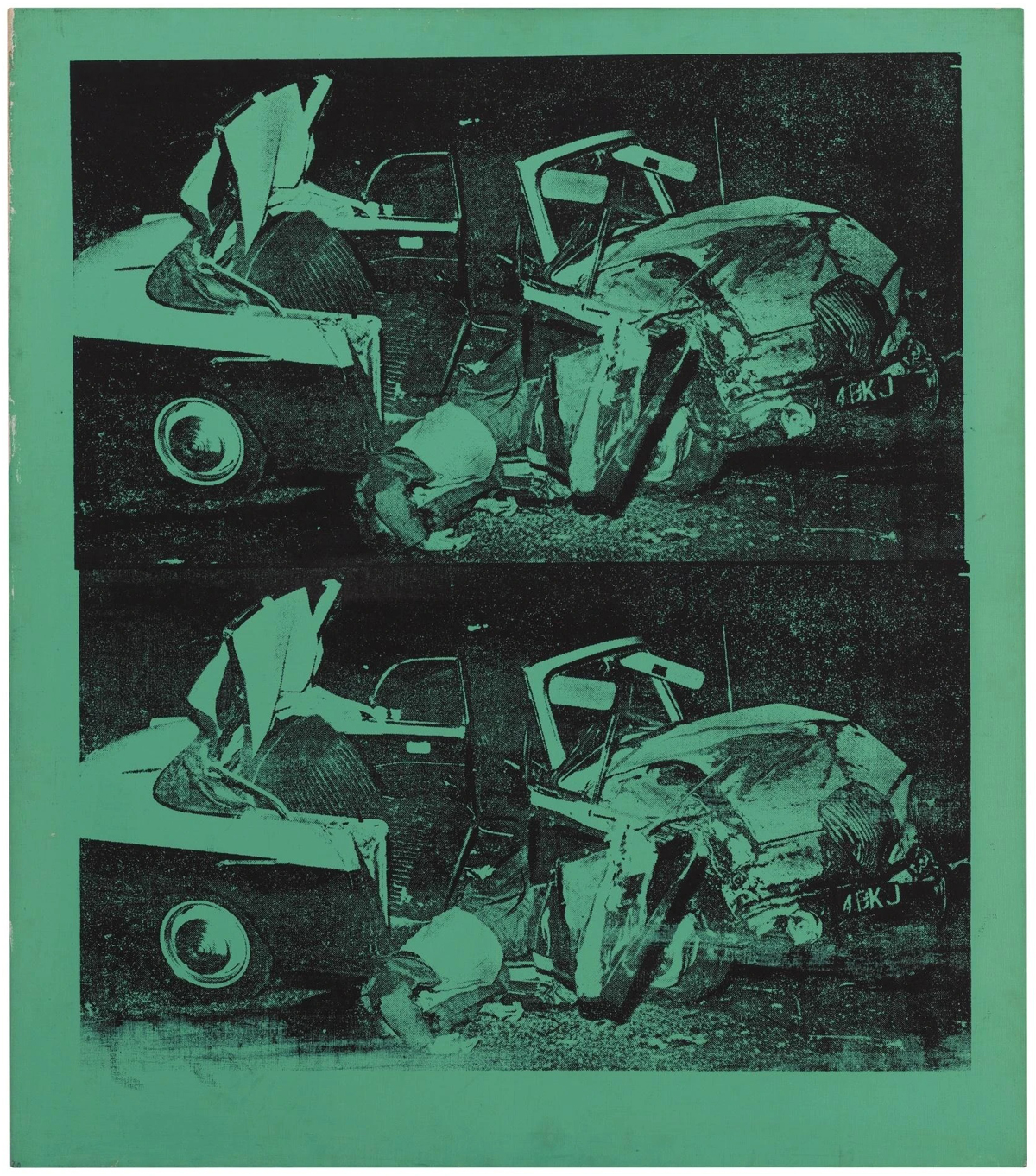
In J.G. Ballard’s Crash, the fetishisation of car accidents follows this loop of visualisation into actualisation. Whilst both desires transcend the human body, Pygmalion and Crash‘s lead fetishist, Vaughan, aren’t perfect parallels. In Pygmalion’s sculpture, and in the many born-sexy-yesterdays stories that follow, the objects of desire remain idealised human figures. Ballard, by contrast, asks what happens when the object of desire is inherently non-sexual (which is, quite literally, the OED definition of a fetish). I feel confident in saying that our pleasure receptors are not designed to trigger in response to two steel boxes colliding at 70mph. And yet the group in this novel find sexuality in both the cars themselves and the acts of their destruction. They are drawn to the phallic “chromium bars” and yonic “radiator grilles”. Whilst they have sex with each other, it is obvious they would cut this out of their process if not to create a deeper connection with their cars, their true objects of desire.
“[Vaughan’s] attraction lay not so much in a complex of familiar anatomical triggers – a curve of exposed breast, the soft cushion of a buttock, the hair-lined arch of a damp perineum – but in the stylization of posture achieved between Vaughan and the car. Detached from his automobile, particularly his own emblem-filled highway cruiser, Vaughan ceased to hold any interest.” (p. 94)
The human sex acts never feel sexy. They are callously described with granular details of perineums, vulvas, penis shafts, scrotal septums, and urethral canals. There is a spiritual mode to the cars and their crashes; the humans are just parts, their bodies like textbooks. When Vaughan takes the prostitutes in his car, his real pleasure is in caressing the steel frame of the windows and fabric of its roof.
Ballard lays it on thick that this obsession has deeper roots. He himself said:
“[Crash is] an extreme metaphor for an extreme situation, a kit of desperate measures only for use in an extreme crisis […] The novel has a political role quite apart from its sexual content, but I would still like to think that Crash is the first pornographic novel based on technology.” (J.G. Ballard, 1995)
He very much uses the novel to interrogate modern life. For him, the crashes are “undreamt sexual unions” (p. 19), death fictions, suicide complexes, celebrity idolatries. Sexuality is just a means to a bigger goal of power or self-worth or self-destruction or really any other core drive which needs a year’s worth of libido to engender it. For James’ relationship with Helen, he describes, “In each sexual act together we recapitulated her husband’s death” (p. 64). For me, the interesting questions are: where do these fetishes come from? what are they representing? are fetishes inherently a modern phenomenon?
If Q.3 = yes, then one possible origin for adding sexuality to the non-sexual might be via associative learning. James works as a network television and commercial producer, Vaughan is a former TV personality, Seagrave a stuntdriver. James’ life is filled with images and clips of news footage with daily coverage of car crashes, celebrity gossip, terrorist attacks, stabbings, and addictive media narratives. He describes early that his TV is always on and he would often make love to his wife with it playing in the background. If car crash reels make up the ambiance of their lovemaking, then these horrifying images may have grafted into his pleasure synapses, his vehicle erections might be Pavlovian.
I’m sure there are many other origins to fetish, but this does make me think it is principally modern. Along with the difficulty of finding historic examples of fetish—aside from representations of real-world sexualities (e.g., Pygmalion and Galatee) or sexual adjacent identities like shoes or hair—in what era has there been such a proliferation of images? Although we have adopted it, I can’t help but point fingers across the pond in some way. Twenty-four-hour news coverage, the advertising complex, and the vice-like grip of consumerism: these were all accelerated by the Americans and the rest of the world followed. Crash is apparently set around Heathrow but it’s impossible to tell. The landscape is described with such grey monotony that it could be London or London, Ohio, and Ballard’s choice of language has the same clarity of origin as, say, Orson Welles’ or Audrey Hepburn’s accents. On one page alone, I made note of elevator, forecourt, avenue, fender, thoroughfare, piazza, shopping mall, motor vehicle; these are the dialect choices of an old-timer emigrant (as Ballard was). Of course, the modern proliferation of images doesn’t turn make us copy American culture, but instead homogenises the objects of those images. After his initial accident, James says, “The crash was the only real experience I had been through in years.” (p. 28). When you consume everything, you value nothing; the images have replaced living. Sontag writes about this very idea:
“A society becomes “modern” when one of its chief activities is producing and
consuming images, when images that have extraordinary powers to determine
our demands upon reality, and are themselves coveted substitutes for firsthand experience, become indispensable to the health of the economy, the stability of
the polity, and the pursuit of private happiness.” (Susan Sontag, On Photography, p. 153)
On Photography uses war photography and news media to propose that a world obsessed with images permanently alters how we view and interact with the world outside of those images. Ballard is doing much the same. Even his characters are directly obsessed with imagery: “Vaughan followed them everywhere with his camera […] For each of them Vaughan devised an optimum auto-death.” (p. 8)
One reason modernity may have mushroomed fetishisation is that imagery acts as the fertiliser to visualisation. James makes a direct reference to this requirement, “In each of these cars I drove along the accident route, visualizing the possibility of a different death and victim…” (p.44). Vaughan and James need a way to picture the scene, to let the desire build up, teased by its possibilities and the simple mantra of: this hasn’t happened yet, but it could. Later in the novel, a taxi nearly crashes into Vaughan out of the blue… “Vaughan swerved in front of it. Tyres screaming over the blaring horn of the taxi. He shouted through his open window at the driver,” (p. 105). This is his fantasy, yet he becomes frustrated because it wasn’t anticipated. It doesn’t release on his terms and he isn’t given the opportunity to get aroused by what could happen.
The imagination is arguably more important than the payoff as the dopamine hit has to get progressively more gratifying. A core part of fetish, and any predilection for desire, is the fix for an increasingly rewarding pay-off, and what may begin with a soft inkling—or toe-dip—towards these behaviours, the next buzz has to be more intoxicating, deeper than the previous. (Veteran narcotics anonymous attendees do not sit circularly to stop their daily morning paracetamols; long-term porn addicts do not jerk it nightly to the image tab of a ‘boobies’ google). The novel starts with James’ initial desires of revisiting the scene of his car crash and seeing the other victim, and ends with the acid-high, ritualistic fucking of his master in a totalled car. The pleasure cycle of visualisation into actualisation gets increasingly distorted if not mediated—this is what makes sex crimes and true, pathological violence so barbaric: they are built towards. All these behaviours are not context-driven, a gambler doesn’t bet because he regularly chances upon unending slotties, they are like bonsai trees, ones grown through meditation. The good news for these spirallers is that as these behaviours are grown into their extremes, they can also be grown out of them. I’m not inherently anti-substance or anti-fetish, in small doses they are controllable (and, importantly, enjoyable), but I’m adamant that if they become the core drivers of why I wake up or why I make certain decisions then, basically, I’m already dead. My bonsai soul needs to be pruned.

Leave a Reply