Mirror’s aesthetic differs from Tarkovsky’s other films, to me. Maybe it’s the flurrying long grass or the delicate sunbeams through log cabin windows, but there’s such joy in every frame. Nostalghia is set amid ruins, Stalker an apocalypse, Solaris a derelict spaceship. They’re purposefully grim, but only to contrast the clear sentiment at the heart of them: hope. As their protagonists soak in their surroundings, like Baudelaire’s flâneur who wanders but doesn’t engage, they’re forced to look inwards to avoid the despair of their environment. Tarkovsky writes in Sculpting in Time, “For me, the most interesting characters are outwardly static but inwardly charged with energy by an overriding passion.” This turning inwards, like Proust did in that lonely attic, has to be an exploration of memory (otherwise, I guess you don’t have a film). Personally, I think all memories are superimposed with an importance that gets embedded within them later on, but if you take those memories for what they are, they’re tiny snapshots that have no meaning in the grand scale of things.
Similar to the impressionist paintings of Monet, these snapshots, or blobs of paint, don’t invite a close study of the pieces but ask the viewer to step back and reflect on the whole—in this case, that a relationship or childhood can’t be evaluated by a single scene or moment, only by the sum of its parts. The American film critic Gene Youngblood (whose existence, for me, begins at “when” and dies at “significant”) writes that “when the content of the message is the relationship between its parts […] all elements are equally significant.” The pink pellet of paint is insignificant compared to the canvas; a water lily is nothing without what it’s submerged in. For Tarkovsky, a single memory is just a drop of water in the proverbial pond when compared to the entire impression of a childhood. It’s best seen through a blur, to close your eyes and let nostalgia consume you. The subjective reimaginings in Mirror are separated from the objective scenes by black-and-white and sepia tones, as if it’s his best imagining but he can’t be certain. He writes, “Memory is a spiritual concept! For instance, if somebody tells us of his impressions of childhood, we can say with certainty that we shall have enough material in our hands to form a complete picture of that person.” The weight is in the recollection, not the event. I’m not sure if I agree.
I think attempting to perfectly reconstruct memory can be fatal. Proust wrote perhaps the most beautiful recollection of childhood. His vision of growing up and how his personal history defined him is so raw and gorgeous at face value, but I can’t help but see the veiled sadness covering all of it. There’s something really, really lonely about someone in their late thirties writing a 3,000-page account of how florid his boyhood gardens were. His sustained mantra, which any reader will infer very early on, is that the past is the only certain state. To him, the present is elusive, a coin flip whose meaning is best judged once the dust has settled. As for the future, well, you’ll have a hard time finding any defenders who back “future” as a certainty, bar Marx or Marley. Proust (and maybe it’s worth tagging Andrei back into the ring) has such an innocent view of our relationship to the past—an innocence that’s borderline pitiable if his prose weren’t one of the few examples of genuine profundity. There’s a sinking feeling to nostalgia. Picturing a true nostalgist on their deathbed is one of the few brain-teasers that triggers me to physically gag. Maybe simpler: to look back on happy memories is sad because it’s an emotional compensation for a present woe; and to look back on sad memories is sad in the same way that tulips are pretty and baby shoes (unless you’re Hemingway) are cute. People forget. People make stuff up. My second gag trigger is the biannual meeting of a mutual friend group twice-removed, who spend the time regaling school stories I seem to have completely wiped from my mind. A temporary mass hallucination I forgot to RSVP to. “Memory is a spiritual concept.” I don’t think I trust myself enough to believe in what I remember, and recalling my Wenderian perfect days, my Malaysian swimming pool to Tarkovsky’s Soviet log cabin—if I think too hard, I think I’ll just cry.
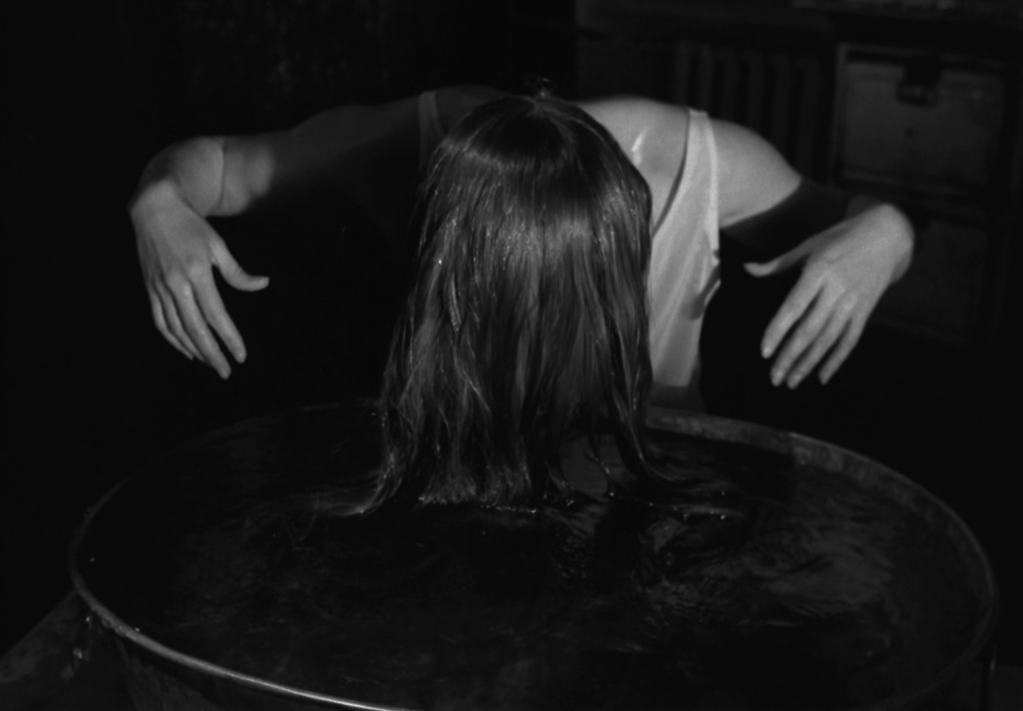
Deleuze, in Cinema (front cover unfortunately w/o a Scorsese double hand raise), calls the distinct parts and their respective positions “an illusion”—the information within the frames are just props on a stage; they are not real. But “the spiritual mode which constantly changes to its own relations”—this, he calls reality. The order in which the scenes are assimilated in the edit reveals the underlying truth; the spirit is in the structure, not the setting. The trivia tidbit that is Mirror’s Mortensenian toe is that Tarkovsky had over twenty completed edits of the film before settling on the final one. He wrote that a film will “edit itself” by finding “the essential unity contained within the material.” Which I think is horseshit if it took twenty edits to find the final one. But perhaps that’s why he’s one of Christianity’s greatest artists and I’m an atheist (who gets his emotional support from the YOU ARE HERE signage at shopping centres): Tarkovsky thinks there’s a true universal order underneath life’s series of frames, and it takes someone truly inspired to find it (i.e., the biblical inspired, as in “God-breathed”).
In the opening chapter of Sculpting in Time, he writes, “A woman wrote from Gorky: ‘Thank you for Mirror. My childhood was like that […] only how did you know about it? […] The feeling of waiting for my mother to come back filled my entire soul […] we really don’t know our mother’s faces.’” This unlocked something in me. Mirror’s biggest compliments are the thrown-around vagaries of: ethereal, dreamlike, unknowable, indescribable, ephemeral, like trying to catch smoke with your bare hands. Words and phrases which Tarkcritics doubly use as whetstones for their critiques. Devout Tarkees then feel like they have to explain why each scene is worth its credit, how each scene links to its neighbours, what the fuck this film is even trying to say. But over time, it seems increasingly obvious that the films which touch me to my very core are the ones that inspire me to forget their content and look back on my life with a Proustian level of clarity, despite all my fears to do so. How hard, how rare, and how special to create a film whose texture and vibe elicit each viewer to explore themselves. In the same way that Proust repaints the forgotten corridors and gardens of our childhood, Mirror unveils the hidden faces who made it all possible.
This, to me, solidifies my hatred of the soullessness of postmodernism. Meta-critiques, coy callbacks, genre-twists, the hermeneutics of audience and text, the incessant parodying, the fear of vulnerability. I think the utter overload of information and media has created a second wave of nihilism. I’m talking about new TV and new films which just have to be so bloody meta that they haven’t got an earnest bone in their body, but I also mean the internet in general. The first wave of nihilism, the (dare I say) Nietzschean wave, was a rejection of meaning, of the structural meaning filtered via religious and political systems. But this wave, seems not to reject meaning, but to imply that we’re incapable of placing it anywhere. When you have access to consume everything, you value nothing. In so many places there needs to be an ecology of meaning; make our worlds smaller. Because in our post-truth internet nihilism, it seems we’re incapable of it in all places except art. And I think now, more than ever, there is a crisis of sentimentality in art, and films like this one are the best reminders as to why it’s so important in the first place.
 Hunting Bears
Leave a comment